
Honest Answers to Every Electrical Question
Transparent answers to common questions about pricing, scheduling, permits, warranties, and more.


Costs vary by job. Outlets typically cost $150 to $250, 100 to 200 amp panel upgrades $3,500 to $5,500, and EV charger installations $1,500 to $2,500. We provide flat-rate quotes upfront so you know exactly what you will pay.
Yes. We provide free, no-obligation estimates for all electrical work. Call us or fill out our online form and we will get back to you the same day.
Absolutely. Once we quote a price, that is what you pay. No hourly surprises, no hidden fees. The price we quote is the price you pay, guaranteed.
In most cases, yes. We offer same-day response and can often be at your door within hours of your call.
Most panel upgrades are completed in one day. Your power will be off for approximately 4 to 6 hours during the swap.
A typical Level 2 EV charger installation takes 3 to 5 hours.
Our 10-point home electrical health check takes approximately 1.5 to 2.5 hours depending on the size of your home.
Yes. We handle all permits and coordinate the ESA inspection for every job that requires one.
Permits are required for panel upgrades, new circuits, EV charger installations, generator hookups, and most renovation electrical work.
An ESA inspection is a mandatory review of permitted electrical work in Ontario. We have a 100% inspection pass rate.
Our lifetime workmanship warranty covers all labour performed by our team. If anything we installed or repaired fails due to our workmanship, we come back and fix it free of charge, for life.
If you are not completely satisfied with our work, we come back and make it right at no charge. No questions asked.
Yes. We are fully licensed by the ESA (Licence #7018179), ECRA registered, and carry comprehensive liability insurance.
Yes. We have partnered with Financeit to offer financing up to $100,000 for electrical work. Apply online in about 3 minutes.
All of our services are eligible for financing: panel upgrades, EV charger installations, generator installations, lighting projects, and more.
Our 10-point inspection includes: panel inspection, breaker testing, outlet grounding, GFCI/AFCI checks, smoke/CO detector testing, visible wiring inspection, exterior assessment, photo documentation, and a same-day written report.
No. The health check is completely no-obligation. You receive a written report and decide what you would like repaired.
Yes. Whether you have a 1,200 sq ft bungalow or a 4,000 sq ft home, the price is $149.99. No exceptions.
A breaker trips when its circuit draws more current than it is rated for, or when there is a fault such as a short circuit. The usual cause is too many high-draw appliances on one circuit, like a space heater and a hair dryer. If it keeps happening, have it checked rather than resetting it again: it can point to a failing breaker, damaged wiring or a circuit that needs splitting.
It can be. A dimmer may feel slightly warm in normal use, but an outlet or switch plate that is hot, discoloured or smells of burning points to a loose or overloaded connection. Stop using it, switch that circuit off at the panel and call a licensed electrician.
Ontario code requires GFCI protection where water and electricity meet: bathrooms, any receptacle within 1.5 metres of a sink (kitchen counters, laundry), outdoor receptacles, crawl spaces, and near pools and hot tubs. The list has grown with each code edition, so older homes often have GFCI protection in fewer places than the current code asks for. Test each one monthly and replace any that will not trip or reset.
Yes. The usual fix is pigtailing: a short copper wire is joined to each aluminum wire with a connector approved for the purpose, so outlets and switches connect to copper. Ordinary wire nuts are not acceptable for this. Where the wiring is damaged in several places, or the walls are already open for a renovation, a full copper rewire can make more sense.
A load calculation answers it. We add up what your home uses now, including heating, air conditioning, the range and the dryer, plus what you plan to add, such as an EV charger or a hot tub. Many homes are well served by 200 amps, and large homes with heavy loads may need 400.
Often, yes. Many Ontario insurers ask about the electrical service when writing a policy, and homes with fuse panels, undersized service, or Federal Pacific or Zinsco panels can face higher premiums or trouble getting coverage. A modern breaker panel installed under an ESA permit gives you documentation to show them.
A sub-panel is a smaller panel fed from your main one. It adds breaker spaces close to where you need them, such as a detached garage, a workshop or an addition. It shares the capacity of your main service, so if that service is already near its limit, an upgrade may need to come first.
It is a good time to. A whole-home surge protector mounts at the panel and diverts surges, whether they come from the grid or from large appliances cycling on and off, before they reach your circuits. It works best alongside plug-in surge protectors for sensitive electronics such as computers and TVs.
Yes. Chargers and connections rated for outdoor use handle the weather, and we mount the unit where the cable reaches your charging port comfortably. The circuit runs from your panel through the wall to the charger, with the same permit and inspection as a garage installation.
Yes. Every electric vehicle can charge at Level 2, whatever the brand, and adapters cover the difference between connector types. We install every major charger brand and help you choose one that fits your car, your parking spot and how far you drive each day.
A load management device watches your home's total use and turns the charger down while other big loads, such as the air conditioner, are running, then back up when they stop. On a panel that is close to its limit, it can let you add a charger without a service upgrade. Our assessment tells you whether it suits your home.
Both work well. A hardwired charger is connected directly to its circuit. A plug-in charger uses a 240-volt receptacle, which makes it easy to take with you if you move. Some chargers come in only one version, so the choice often follows the model you want. We install either.
As a starting point, about four to six feet apart, with the lights nearest the walls two to three feet from them. The right spacing depends on the ceiling height, the beam angle of the fixture, and whether you want general light across the room or task light over a counter. We plan the layout before we start.
Usually because the dimmer was designed for incandescent bulbs. Older dimmers can make LEDs flicker, buzz or dim over only a short range. A dimmer rated for LED loads and matched to the fixtures normally fixes it.
Yes, with the right fixture. Under an insulated ceiling, such as a top floor or a cathedral ceiling, pot lights must be IC-rated, meaning rated for contact with insulation. A fixture without that rating needs clearance from the insulation, and using one where it cannot have that clearance is a fire hazard and a code violation.
Usually more circuits than the old kitchen had. Receptacles near the sink need GFCI protection, major appliances often need their own circuits, and new lighting such as pot lights and under-cabinet strips is wired in at the same stage. The work needs an ESA permit, and in an older home, opening the walls can reveal wiring that must be updated first.
From the first visit to the final ESA sign-off, a typical installation takes two to four weeks, mostly waiting on permits and equipment. The electrical connection itself usually takes a full day at your home.
No. Backfeeding a generator through an outlet is illegal and can electrocute utility workers on the lines. Connect it through a transfer switch or a GenerLink, and always run it outdoors, at least 20 feet from windows and doors, because the exhaust contains deadly carbon monoxide.
For short outages and a few critical circuits, it can be. A single home battery typically stores 10 to 15 kilowatt-hours, which runs a modest 5-kilowatt load for about two to three hours. A natural gas standby generator runs as long as the gas flows, which matters when an ice storm keeps the power off for days. Some homes combine the two.
About two hours. The GenerLink fits between your meter and the meter base, so the utility pulls the meter briefly. We coordinate that, take out the permit and arrange the ESA inspection.
It depends on the battery's capacity and what you are running. A typical home battery holds 10 to 15 kilowatt-hours, enough for a modest 5 kilowatt load over about two to three hours. Back up only the essentials, such as the furnace blower, the fridge, the sump pump and some lights, and the same battery lasts far longer. Our battery runtime estimator gives you a starting figure, and the load assessment gives you the real one.
Yes. In Ontario almost all electrical work must be reported to the Electrical Safety Authority (ESA) with a notification of work, the permit, before it starts, and a battery system wired into your panel is no exception. We file it, the installation is inspected, and ESA issues a Certificate of Acceptance once the work passes.
Yes, and for a home that wants both an instant switch-over and a long runtime it is a good fit. The battery carries the short outages and the first hours of a long one silently; when it runs low, the generator starts, carries the house and recharges the battery. Our generator and battery estimator shows how the two share the work.
It can change when you buy power. Ontario's time-of-use and ultra-low overnight plans charge less overnight and more at the peak, so a battery that charges in the cheap hours and runs the house in the expensive ones moves your usage to the lower price. The saving is on the electricity price only, not on delivery charges, and the Ontario Energy Board sets the prices once a year on November 1. Our time-of-use estimator uses the current prices.
Both. Our licensed electricians serve commercial buildings across Hamilton, Niagara and Southern Ontario: maintenance and service, infrared inspections, service upgrades and three-phase power, equipment hook-ups, tenant fit-outs, LED retrofits, EV charging and standby generators.
A thermal camera scan of your panels, connections and equipment while they are running. Loose connections and overloaded circuits heat up before they fail. Finding them early means a scheduled repair instead of a shutdown, a fire risk removed, and a report you can show your insurer.
Yes. Retrofits, fit-outs and service work are scheduled around your hours, by area or after close, and any planned shutdown is agreed in advance.
Yes. Remarkable Electric holds ESA Licence #7018179 and carries liability insurance. Permits and Electrical Safety Authority inspections are included in commercial work.
No. We install and connect equipment and provide the power, disconnects and motor circuits. PLC and controls programming stays with your equipment vendor or integrator.
By written quote after a site visit or from your drawings, with the scope fixed and any changes agreed in writing. Maintenance programs are priced as a fixed scope and schedule.
Yes. Load calculations, utility applications, Electrical Safety Authority permits and inspections are handled by us and itemized in the quote.
Yes. Planned maintenance programs on a monthly, quarterly or annual cycle, which can include infrared inspections, emergency lighting tests and generator exercise.
The checks agreed in your maintenance program. Panels, distribution, lighting and critical circuits are inspected and serviced, with torque checks, breaker replacement, load balancing and panel clean-up where needed, and emergency lighting and exit signs are tested. Findings are documented, and deficiencies are corrected or scheduled.
Call us. Outages and faults that stop your business get a same-day response with a licensed electrician on site, and the problem is traced to the cause and fixed, not patched.
Each finding is photographed in visible and thermal images, located on your panel schedule, rated by priority and paired with the recommended repair. The report is formatted for insurers, landlords, buyers and property managers who ask for evidence of electrical condition.
Yes. We are licensed electricians, so findings can be corrected on the spot or scheduled, then re-scanned to confirm the fix.
It depends on what you are adding. Motors, compressors, commercial kitchens and machinery often need three-phase supply. A load calculation during the site visit shows whether your existing service can carry the new load or needs a larger single-phase or a three-phase service.
While the service is changed over, on a date agreed with you in advance. The service change is scheduled with the local utility so downtime is planned and short.
The equipment specifications, including the electrical requirements on its nameplate or in the manual (voltage, phase and current), and a site visit to see where it will go and what supply is available. From those we size the feeder, breaker and disconnect and quote in writing.
Yes. Fit-outs are quoted from drawings or a site visit. Where the electrical layout is not settled yet, receptacle, lighting and equipment layouts are worked out with you, your designer or your contractor before the walls close.
Yes. Electrical Safety Authority permits and inspections are part of the job, and you receive the certificate your landlord or municipality asks for.
Both are options. Troffers, high bays, strip lights and downlights are replaced or converted to LED, with the light levels your space needs, and the quote follows a fixture count and a look at your existing wiring and controls.
Yes. Occupancy sensors, daylight controls and timers can go in with the retrofit and cut the hours the lights run.
Not always. Your service and panel capacity are measured against the chargers you want now and later, and load management lets a bank of chargers run on the service you have instead of forcing a full upgrade.
Sometimes. Incentives that apply to your project are identified during the quote.
It depends on what you want to keep running. A home usually chooses between essential circuits (furnace, fridge, sump pump, some lights) and whole-home coverage. A business lists its critical loads. We measure and size from that list.
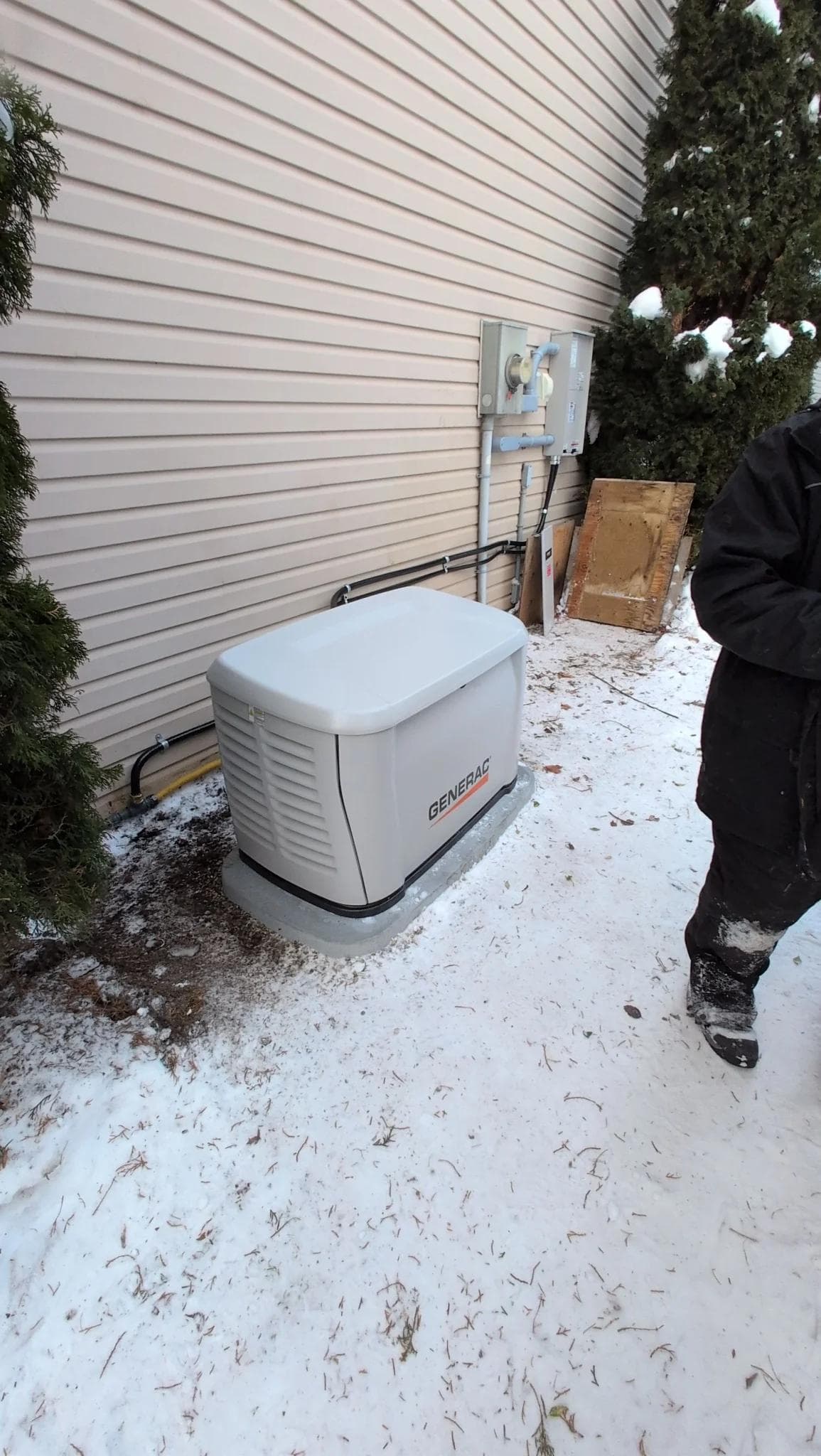
A GenerLink lets a portable generator feed your panel safely through the meter, and you start it yourself. A standby generator starts on its own within seconds and runs on natural gas or propane. Our portable vs standby guide compares them side by side.
Both. We install and service the brands we carry, so installation, start-up, warranty service and maintenance are handled by the same licensed crew.
At least once a year, plus its weekly self-test. Oil, filters, battery and fuel supply are checked on a schedule, and we offer maintenance plans for homes and businesses.
Yes. An Electrical Safety Authority permit and inspection are required, and the gas connection is coordinated with a licensed gas fitter. Both are part of our installation.
Still Have Questions?
Call us or send us a message. We are happy to help.
Call Us
(289) 210-5221Service Area
Hamilton, Niagara & Southern Ontario
Hours
Open 24 hours, 7 days a week
Our Promise
Satisfaction Guaranteed or We Come Back Free